Local citations are online mentions of your business name, address, and phone number. They appear in directories, on review sites, in news articles, and anywhere else your business information gets published. Google uses them to verify that your business is real, that it operates where you say it does, and that it deserves to show up when someone nearby searches for what you sell. So what are local citations exactly, how do they work, and why do they carry so much weight in local SEO? We’ve been building and cleaning up citations for local businesses since 2008. Here’s the full picture.
What Is a Local Citation?
A local citation is any online reference to the three primary components of your business identity, called the NAP:
- Name
- Address
- Phone Number
Your NAP is unique to your business, and it has to be cited correctly and consistently to count as a proper citation. Just like Google uses links to your website as a trust signal, it also uses local citations to assess the authority of your business. Citations are different from links in one useful way: they don’t have to link to your site for you to get credit. A citation can be printed in plain text and still do its job.
Local Citation Examples
Citations come in two forms:
- Structured citations are your business details listed in a formatted profile: your Google Business Profile, Yelp listing, Bing Places page, Apple Maps listing, a chamber of commerce directory, or an industry directory. These are the most common type.
- Unstructured citations are mentions of your business inside regular content: a local news article that names your business and address, a blog post that mentions your shop, or a sponsor listing on a local event page.
A simple example: your business name, street address, and phone number printed on a local business association’s member page is a citation, whether or not it links anywhere.
What Do Local Citations Do?
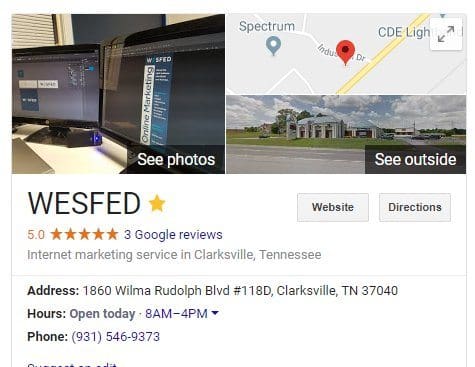 The local WESFED map listing
Citations give Google a way to substantiate your business information from a variety of independent sources. They help place your business in map results because they confirm that your business exists, that it’s legitimate, and that the details published about it are true. When Google trusts the business, the business ranks higher. And this now matters beyond Google: AI search tools like ChatGPT, Perplexity, and Google’s AI Overviews pull business details from the same public data sources. If your information is inconsistent across the web, you’re harder to verify and harder to recommend, for both the algorithms and the AI assistants your customers ask.
How Do Local Citations Work?
When Google finds your company’s information on citation directories and other websites, and that information matches what’s on your website and your Google Business Profile, the search engine gains confidence that your business operates in the specified location. As a result, Google can confidently display your listing whenever someone searches for the services or products you offer. People looking for what you sell can actually find you. That translates to more calls, more customers, and more revenue.
The reverse is also true. If one directory says Suite 200, another says Suite 2, and a third lists your old phone number, Google has conflicting information and less reason to trust any of it. Inconsistent citations are one of the most common problems we find when auditing local businesses.
Where Can Local Citations Be Obtained?
A lot of people assume the only way to get a citation is through a directory. Directories are valuable, but they’re not the only option. Citation sources include:
- General business directories
- Local newspapers
- Press websites
- Directories tied to a specific sector, industry, or niche (travel directories or medical directories, for example)
- Locally themed blogs (local blogs covering a specific industry, such as nightlife, spas, etc)
- Highly regarded local websites
- Social profile pages
- Industry-specific forums
- Sites where questions can be asked and answered
- Bylines linked to guest posts and articles
Core Elements of a Local Citation
The essential elements of a local citation are:
- The name of your business
- The address of your business
- The phone number of your business
There are additional components that can be included, such as:
- A link to a specific website or page
- Your business categories; for an interior design business, these might include home decor or home furnishings
- Your hours of operation
- Directions to your business
- A description of your business
- Photos
- Videos
- The types of payments your business accepts
- Your company’s email address
- Taglines
- Reviews of your business
- The geo-coordinates of your establishment
- Links to social media profiles
- Additional phone numbers
- The attributes of your business
How Can You Create Local Citations?
The most important rule of citation building is consistency. The more consistent your citations are, the easier it is for Google to pick them up, assess them, confirm their credibility, and connect them to your business.
A useful tip: go directly to the source. Search your business address on Google Maps and note exactly how your address appears in their mapping database. Use the address exactly as it appears there, and use it the same way every single time, on every directory, profile, and page. Pick one format for your business name too. “Smith Plumbing LLC” and “Smith Plumbing & Heating” look like two different businesses to a machine.
Start with the major platforms (Google Business Profile, Bing Places, Apple Maps, Yelp, Facebook), then move to industry and local directories. Fix existing wrong listings before chasing new ones. Cleanup beats volume.
Why Local Citations Are Important for Local Businesses
Local citations benefit local business owners in two specific ways:
They help boost search engine rankings
The more citations your business has, the more accurate their information, and the higher the quality of the sites they live on, the stronger the signal to Google. Google collects information about your business from across the web, and the more of it that checks out, the more confidently it can rank you. Remember, though: the information in your citations must be consistent. If it isn’t, your rankings can suffer.
They help influence consumers
When your citations are accurate, people searching for your products and services can actually reach you. They get your correct phone number, your correct address, and the other details they need. That means more phone calls, more website traffic, and more foot traffic. If your citations are wrong, potential customers get misdirected, and that hurts both your reputation and your revenue.
Local Citation Recap
Local citations contain key information about your business: its name, physical address, and phone number, plus any other details customers would find useful. When they’re accurate, consistent, and placed in the right locations, citations strengthen your local rankings and make your business easier for both search engines and AI assistants to recommend. Citation consistency is one of the seven areas we check in our free marketing audit. Run one and see exactly where your business information is right, wrong, or missing.
Local Citations FAQ
What are local citations in SEO?
Local citations are online mentions of your business name, address, and phone number (NAP). Search engines use them to verify your business information and decide how prominently to show your business in local search and map results. They work even when they don’t link to your website.
What is an example of a local citation?
Your Yelp listing is a structured citation: your name, address, and phone number in a formatted profile. A local news article that mentions “Joe’s Bakery on Main Street in Clarksville” is an unstructured citation. Both count, and both should match the details on your website exactly.
Do local citations still matter in 2026?
Yes. They’re not the strongest local ranking factor (your Google Business Profile, reviews, and proximity matter more), but inconsistent citations actively hurt you, and AI search tools rely on the same public business data when recommending local businesses. Clean, consistent citations are baseline hygiene.
How many local citations do I need?
There’s no magic number. Accuracy beats quantity. Cover the major platforms and the directories relevant to your industry and city, and make sure every one of them matches. A business with 30 consistent citations is in better shape than one with 300 conflicting ones.