
SEO writing is the practice of creating content that ranks in search engines and actually helps the person who finds it. An SEO writer researches what people type into Google, figures out what they want, and writes content that answers it better than whatever is already ranking. That is the whole job in one sentence.
We have been doing this work since 2008, and the fundamentals have outlasted every algorithm update: know what your reader wants, answer it clearly, and make the page easy for machines to understand. What has changed is the toolset and where people search. This guide covers the fundamentals first, then gets into how AI writing tools and AI search have changed the work in 2026.
What is SEO writing and why does it matter?
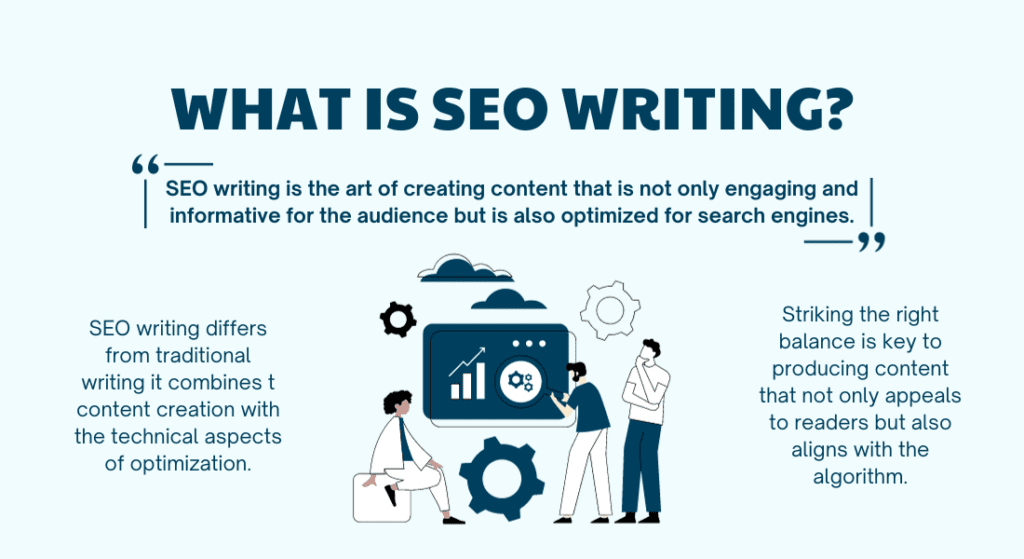
SEO writing is content creation with two audiences in mind at once: the human reading the page and the search engine deciding whether to show it. Get both right and your content earns organic traffic month after month without you paying for a single click. Get only one right and you either have a great article nobody finds, or a keyword-stuffed page nobody reads.
The process behind SEO content writing is strategic. You pick keywords based on real search data, match the content to the searcher’s intent, and follow on-page best practices so search engines can index and understand the page. Google refines its algorithms constantly, so part of the job is staying current with what it rewards.
What separates SEO writing from other writing is the balance. You need the clarity and craft of good writing plus the technical discipline of optimization. Lean too far toward the machine and the content reads like a robot wrote it. Lean too far toward pure prose and it never gets found.
SEO writing vs. traditional writing
Traditional writing delivers a message to an audience you already have. SEO writing earns an audience you do not have yet. That single difference drives everything else.
A traditional writer starts with an idea. An SEO writer starts with a search query and works backward: who searches this, what do they actually want, and what would the most useful page on the internet for this query look like? None of that means sacrificing quality. It means aiming the quality at a specific, provable demand.
The best SEO writers move between both worlds without the seams showing. The reader never notices the optimization. Google never misses it.
Keywords and search intent
The role of keywords in SEO writing
Keywords are the terms people type into search engines. They are the backbone of SEO writing because they are the only direct evidence you have of what your market wants. Optimize your content around relevant keywords and it has a chance of appearing when those searches happen. Skip that step and you are publishing into the void.
There is a limit, though. Cramming keywords into every sentence, called keyword stuffing, has been penalized by Google for well over a decade. Use the keyword naturally in the title, in a heading or two, in the opening, and wherever it genuinely fits. Then stop. If a paragraph reads worse because of a keyword, take the keyword out.
Search intent: what the searcher actually wants
Every query has an intent behind it. Someone searching “what is seo writing” wants a definition and an explanation. Someone searching “seo writer for hire” wants to spend money. Same topic, completely different pages.
Matching intent matters more than matching words. Google has become very good at recognizing when a page satisfies searchers and when it sends them straight back to the results. Before you write anything, search your target keyword and look at what ranks. The current top results tell you what Google believes the intent is. Your job is to serve that intent better, not to argue with it.
Google Search Console and Google Analytics show you which queries already bring people to your site and what they do when they arrive. That data is free and most businesses never look at it.
How to find the right keywords
Keyword research is the foundational step. Tools like Google Keyword Planner, Semrush, or Ahrefs show you search volume, competition, and related phrases for any topic. Weigh all three: a keyword you cannot realistically rank for is worth less than a smaller one you can own.
Long-tail keywords, the longer and more specific phrases, deserve special attention. “SEO” is unwinnable for most sites. “SEO writing checklist for real estate agents” is winnable, and the person searching it knows exactly what they want. Lower volume, higher intent, more qualified traffic. A healthy content strategy mixes both: broader head terms for reach, long-tail phrases for conversions.
If you want a simple process, this is ours in four steps:
- List the questions customers actually ask you. Sales calls, support emails, and Google Business Profile questions are keyword research nobody has to pay for.
- Run those topics through a keyword tool. Confirm real search demand and collect the exact phrasing people use.
- Check the competition manually. Search each candidate keyword and judge whether you can realistically produce something better than the current top results.
- Map one primary keyword to one page. Two of your pages chasing the same query split your own strength. Give each search one clear home on your site.
Writing content with SEO in mind
Quality and relevance come first
Search engines exist to answer questions well. Content that answers questions well is what they want to rank. That alignment is the entire strategy. Every trick that tries to shortcut it eventually gets filtered out.
Aim to be the most reliable source on your specific topic, at whatever scale you operate. Reliable content attracts links from other sites, and links remain one of the strongest ranking signals there is. It also earns return visitors, branded searches, and citations in AI-generated answers, all of which compound over time.
Write with a clear picture of your reader. What problem brought them here? What do they already know? What do they need to hear before they will act? Content built on those answers gets shared and linked. Content built on a word count target does not.
On-page optimization that actually matters
Optimization goes beyond keywords in the body copy. The elements that consistently matter:
- Title tag and meta description. These are your ad in the search results. The title needs the keyword; the description needs a reason to click.
- Headers (H1, H2, H3). They give the page structure for readers and context for search engines. Put key phrases in headings where they fit naturally.
- Internal links. Link related pages on your own site together. It helps readers keep going and helps Google understand how your content connects.
- External links. Cite authoritative sources. It signals care and gives readers a way to verify claims.
- Freshness. Update posts when facts change. A refreshed, accurate page beats a stale one, and search engines notice the difference.
Does length matter?
Long-form content tends to rank well, but not because Google counts words. Longer pieces usually cover a topic more completely, target more related phrases, earn more links, and hold attention longer. Those are the actual ranking advantages; length is just the side effect.
The rule is: as long as the topic requires, no longer. A 400-word answer that fully resolves a simple question beats 2,000 words of padding every time. We cover the practical word count ranges in detail in our guide to the ideal blog post length for SEO.
Whatever the length, structure it for humans. Short paragraphs, descriptive subheadings, images and examples where they help. People scan before they read. Give scanners a reason to stop.
What makes a good SEO writer?
The skills that matter
A good SEO writer is more than a writer who knows what a keyword is. The skill set includes:
- Research. Keyword research, competitor analysis, and enough subject-matter digging to write with authority.
- Data literacy. Reading Search Console and analytics well enough to know what is working and what to fix.
- Adaptability. Search behavior shifts, algorithms shift, and formats shift. Writers who update their methods stay employed.
- Range. Blog posts, service pages, product descriptions, and FAQ content all follow different rules. A strong SEO writer handles all of them while keeping the brand voice consistent.
Balancing creativity and optimization
Optimization should never be visible in the finished piece. Effective SEO copywriting works the target phrases in without breaking the flow, and a reader who knows nothing about SEO should just experience a clear, useful article.
Compelling headlines, direct introductions, and a conversational tone do double duty: they keep humans reading, and human engagement is exactly what modern search rankings reward. Think about the full journey from the search results click to your call to action, and make every section earn the next one.
Freelance SEO writing
Plenty of people search “what is an SEO writer” because they are considering the career. The short version: yes, it is a real and in-demand job, and the freelance path is viable if you treat it like a business.
Freelance SEO writers need the craft plus the business side: a portfolio with measurable results (“this post ranks #3 for X”), clear positioning, and dependable delivery. Results you can point to matter more than any certificate. The writers who struggle in 2026 are the ones selling undifferentiated word production, because AI tools drove the price of undifferentiated words to nearly zero. The writers who thrive sell judgment: strategy, subject expertise, and content that demonstrably performs.
How AI writing tools changed SEO writing in 2026
This deserves its own section, because no development has changed the day-to-day work of SEO writing more since we started in 2008.
AI writing tools are now standard equipment. We use them in our own work and we are not shy about it. They are genuinely good at first drafts, outlines, rewording, summarizing research, generating title options, and producing variations for testing. What used to take a writer three hours now takes forty-five minutes.
Here is what the tools did not change: the output only ranks if it is accurate, matched to intent, and better than the competition. Anyone can now generate a generic 1,500-word article in thirty seconds, which means generic 1,500-word articles are worth exactly nothing. Google’s guidance is consistent on this point: it rewards helpful, reliable content and demotes unhelpful content, regardless of whether a human or a machine typed it. The bar did not drop. The bar went up, because the floor got crowded.
So the skill moved. SEO writing in 2026 is less about typing and more about two things:
- Direction. Knowing what to ask for. The writer who feeds an AI tool a real content brief, actual keyword data, correct facts about the business, and a defined audience gets usable material. The writer who types “write a blog post about plumbing” gets filler.
- Editing. Everything a model produces needs a human pass for factual accuracy, original insight, brand voice, and the first-hand experience that generic output cannot fake. The edit is where the ranking potential gets added.
Treat AI as a fast junior writer on your team: valuable, tireless, and never allowed to publish without review. Businesses that publish raw AI output at scale are running a strategy that Google’s spam and helpful-content systems are specifically built to catch. Businesses that use AI to produce more well-directed, well-edited content are simply outworking their competitors.
In practice, a healthy AI-assisted writing workflow looks like this:
- Brief first. Target keyword, search intent, audience, the points that must be covered, and the facts and examples only your business knows.
- Draft with the tool. Let it produce structure and a first pass fast. This is where the time savings live.
- Verify every claim. Models state wrong things confidently. Any statistic, date, name, or technical detail gets checked before it survives the edit.
- Add what only you have. Your examples, your data, your opinion, your local knowledge. This step is the difference between content that ranks and content that blends in.
- Edit for voice. The finished piece should sound like your business, not like every other AI-assisted page published that day.
Notice that four of the five steps are human judgment. That ratio is the point.
SEO beyond the keyword: experience, local, and social
User experience is part of the job
Search engines measure how people experience your pages. Page speed, mobile usability, and sensible site structure all factor into rankings, and they all affect whether a visitor stays or bounces.
As a writer, you control more of this than you might think. Well-organized content with clear navigation and scannable structure keeps people on the page. Compressed images load faster. Descriptive subheadings help readers find their answer. None of this is separate from SEO writing; it is SEO writing.
Local SEO: writing for a geographic market
If your business serves a physical area, your content should say so. Local SEO means working location-based phrases naturally into your pages, keeping your Google Business Profile complete and accurate, and holding your name, address, and phone number consistent across every directory that lists you.
Reviews carry real weight here. They build trust with potential customers and influence local rankings. Content-wise, pages that speak to local specifics, like neighborhoods you serve or local problems you solve, consistently outperform generic pages with a city name bolted on.
Social media and SEO: the honest version
Social shares are not a direct ranking factor, and anyone telling you otherwise is selling something. What social media actually does for SEO is distribution: it puts your content in front of people who might link to it, cite it, or search for your brand later. Links and brand signals do move rankings.
So write content worth sharing, promote it where your audience actually is, and build relationships with people who publish in your space. The SEO benefit is indirect but real.
Measuring whether your SEO writing works
Rankings and what they miss
Rankings are the obvious scoreboard: where does your page sit for its target keyword? Track them, but do not stop there. A #1 ranking for a keyword nobody searches is a trophy for an empty room.
Click-through rate tells you whether your title and description earn the click once you rank. Organic traffic tells you the total search visibility of the site. Engagement metrics like time on page tell you whether the content delivers once people arrive. A page can rank well and still fail at every step after that.
The metrics that matter
Google Search Console shows you queries, impressions, clicks, and average position for free, and it is the single most useful report for an SEO writer. Google Analytics adds behavior: where visitors land, where they go next, and whether they convert.
Conversions are the metric your business actually cares about. Form fills, calls, purchases. Tie your content to those outcomes and you will know which posts earn their keep. Tools like Semrush, Ahrefs, and Moz round things out with backlink data, site health audits, and competitor tracking.
Adapting based on what you learn
SEO rewards iteration. Review your data on a schedule, find the patterns, and act on them. Topics that perform get sequels and deeper coverage. Pages that rank on page two get refreshed and strengthened, because moving position 15 to position 5 is usually easier than ranking a brand-new page.
Watch industry news for algorithm updates, but do not panic-chase them. Sites built on genuinely useful content tend to ride updates out. Sites built on shortcuts do not.
Common SEO writing mistakes
Keyword stuffing
Still the classic mistake, decades after it stopped working. Repeating a keyword unnaturally throughout a page does not help you rank; it actively hurts, and it makes the writing unreadable, which hurts a second time through engagement.
Write the piece for the reader first, then check that the keyword appears in the title, the opening, and a heading or two. If it reads naturally aloud, you are fine.
Writing for robots instead of people
The mirror-image mistake: content assembled to satisfy a checklist with no thought for the human on the other end. It has the keyword, the headings, the word count, and no reason for anyone to read it.
Google’s ranking systems in 2026 lean heavily on whether content demonstrates real experience and satisfies real people. Bring specifics: your own examples, your own data, your own opinions. That is the material no competitor and no AI model can copy.
Outsourcing everything and checking out
Hiring an SEO agency or writer can absolutely be the right move. Handing them the keys and never looking at the work is not. You know your customers, your industry, and your business better than any outside partner ever will, and content built without that knowledge comes out hollow.
Whoever does your SEO, stay involved: share what customers actually ask you, review the content before it publishes, and insist on reporting you understand. Good partners welcome that. Bad ones discourage it, which tells you what you need to know.
What good SEO writing looks like
A few patterns we see work over and over, across industries:
The definitional guide. A page that fully answers a “what is X” query: clear definition up front, thorough explanation after, structured with descriptive headings. This post is one. These pieces earn steady traffic for years and get cited by AI answer engines because they are easy to extract accurate answers from.
The honest comparison. “X vs. Y” content that genuinely weighs both options instead of shilling one. Searchers with comparison intent are close to a decision, and the page that helps them decide earns the trust and often the sale.
The experience-backed answer. A post that answers a common customer question using real examples from your own work. Weakest on paper, strongest in practice, because it demonstrates the first-hand experience that both Google’s quality guidelines and human readers reward.
The local service page. A page targeting “service + city” that talks about the actual area, actual problems, and actual proof of work there. Boring, unglamorous, and frequently the highest-converting SEO writing a local business owns.
The common thread: every one of them starts from a real search and serves it completely.
Where SEO writing is headed
AI search and answer engines
People increasingly get answers from ChatGPT, Perplexity, and Google’s AI Overviews instead of clicking through ten blue links. That changes the SEO writer’s target: your content now needs to be quotable by machines as well as rankable by them.
The practical adjustments are familiar: answer questions directly and early, structure content with clear headings, include FAQ sections, and keep facts precise, because AI systems favor sources they can extract clean answers from. Optimizing for this is its own discipline now, often called AEO, and it is a core part of how we approach search visibility for clients. The good news: content written clearly for humans is most of the way there already.
E-E-A-T and first-hand experience
Google’s quality framework, E-E-A-T, stands for experience, expertise, authoritativeness, and trustworthiness, and the first E is the one to watch. In a web flooded with synthesized content, evidence that a real person with real experience stands behind the page is a differentiator. Author bios, original photos, specific case details, and honest opinions all signal it.
More formats, same fundamentals
Video keeps growing, voice queries keep favoring conversational phrasing, and new formats will keep arriving. The writers who do well treat each one as a new container for the same job: understand the search, answer it well, make it easy to consume.
Key takeaways
- SEO writing serves two audiences at once. The reader gets a clear, useful answer; the search engine gets structure and relevance signals.
- Start from search data, not from ideas. Keyword research tells you what your market actually wants.
- Match intent before anything else. The page that satisfies the search wins, whatever its word count.
- Quality is the strategy, not a nicety. Helpful, reliable content is what every ranking system is trying to find.
- Optimize the whole page. Titles, descriptions, headings, links, and freshness all count.
- Use AI tools, and edit everything. Direction and editing are the skills; raw output is a starting point, never a finished product.
- Measure past the ranking. Clicks, engagement, and conversions tell you whether the content actually works.
- Show your experience. Specifics from your own work are the one ingredient nobody can duplicate.
- Write for answer engines too. Direct answers, clean structure, and FAQ sections earn citations in AI search.
- Stay involved even when you outsource. Your business knowledge is what turns competent content into effective content.
Good SEO writing is not a trick. It is the discipline of answering real questions better than anyone else, in a format both people and machines can use. Do that consistently and the traffic follows.
FAQ
What does an SEO writer do?
An SEO writer researches what people search for, then plans and writes content designed to rank for those searches. The day-to-day work includes keyword research, studying competing pages, writing and structuring content, optimizing titles and headings, and reviewing performance data to improve what is already published. In 2026 the role also includes directing and editing AI writing tools rather than drafting everything by hand.
What is the full form of SEO in writing?
SEO stands for search engine optimization. SEO writing, sometimes called SEO content writing or SEO copywriting, means writing content that is optimized to rank in search engines like Google while remaining genuinely useful to the person reading it.
What is an example of SEO writing?
A guide that targets a real search query is the classic example. This post targets “what is SEO writing”: the phrase appears in the title and headings, the opening answers the question directly, and the structure uses clear subheadings so both readers and search engines can follow it. Product pages, service pages, and FAQ content written around specific queries are SEO writing too.
Can AI replace an SEO writer?
AI has replaced the typing, not the job. The parts of SEO writing that determine whether content ranks, like choosing the right target, matching search intent, verifying facts, and adding first-hand experience, still require human judgment. We use AI tools daily in our own content work, and the writers directing and editing them produce far better results than the tools do alone. The role has shifted from producing words to directing and refining them.
Is SEO writing the same as copywriting?
They overlap but are not identical. Copywriting persuades a reader to take an action, like buying or signing up. SEO writing attracts readers from search engines by answering their queries. The strongest commercial content does both: it earns the visit through search and then earns the conversion through persuasion.