Do Google reviews help SEO? Yes. Reviews are a confirmed factor in local map pack rankings, and they indirectly lift your regular organic rankings through higher click-through rates and stronger trust signals. Google’s own guidance for Business Profiles says that high-quality, positive reviews can improve your business’s visibility. But reviews are not a magic ranking button, and the way they help is more nuanced than most articles admit. Below we’ll cover how much Google reviews matter, where they directly affect rankings, where the effect is indirect, and what that means for how you should approach your SEO.
How Important Are Google Reviews?
For this post we’re focusing specifically on Google reviews. Google reviews aren’t fundamentally different from Facebook or Yelp reviews (we’ll touch on both below), but since Google surfaces reviews directly in search results and map listings, they’re the ones with the most visible impact.
BrightLocal’s ongoing local consumer review survey consistently finds that the large majority of consumers read reviews for local businesses and trust them about as much as personal recommendations. That’s easy to believe. 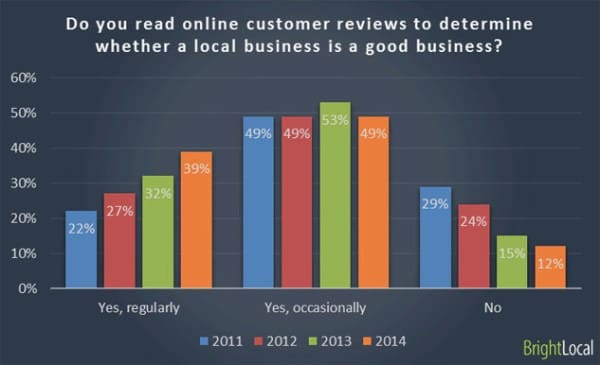 Think about the last time you bought something from Amazon, Walmart, or any other online retailer. Chances are you looked at the reviews. Actually, I’m willing to bet you absolutely looked at the reviews. You’re no different from the customers who buy from you. Nobody intentionally chooses a 1-star option over a 4.5-star option. Plain and simple, reviews shape how a potential customer perceives a product, service, or company before they ever contact you.
Do Google Reviews Help Local Rankings Directly?
For the local map pack, yes. Google has confirmed that review signals factor into local ranking as part of “prominence,” one of the three pillars of local search (relevance, distance, and prominence). Review count, review score, and the recency of your reviews all contribute to how prominent Google considers your business. This is one of the few ranking inputs Google openly acknowledges.
But reviews don’t override everything else. I’ve worked with businesses whose map rankings were low even though they had over 50 positive reviews, while competitors ranked above them with fewer than ten reviews, worse ratings, and in some cases no website at all. 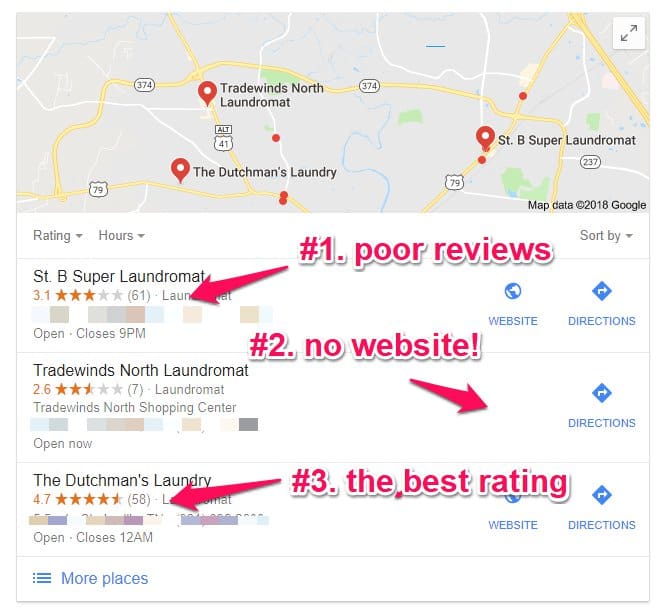 The #3 ranked laundromat above has a better rating, more reviews, and a website, yet still sits below competitors. Proximity, relevance, category selection, and the overall strength of your local SEO (your Google Business Profile, your website, your local citations) all weigh in alongside reviews. Reviews are one strong ingredient, not the whole recipe.
Do Google Reviews Help Organic Rankings?
For your regular organic listings (the standard results below the map), the effect is indirect. Google reviews are not a direct ranking factor for organic search on Google, Bing, or other search engines. But indirect doesn’t mean small. Here’s where the value shows up.
Increased Click-Through Rate
Shoppers love reviews. Even when a business ranks #3 in the map pack, users often click it first based on rating alone. That increase in clicks to your website can influence your rankings over time, as long as you provide value once the user is there. If your listing attracts clicks but your site doesn’t deliver what people expected, they bounce back to the results and pick someone else, and Google notices that pattern across many users. Better reviews earn higher click-through rates; a useful website converts that attention into engagement; and that combination supports stronger rankings.
Increased Trust and Potential to Convert
People buy when they feel comfortable, and nothing is more uncomfortable than considering a business rated 1 star. When your reviews are high in both rating and volume, they tell potential customers three things:
- Your business has made real people happy before (social proof is a huge influencer)
- Your business makes customer satisfaction a priority
- Your business does good work
The more comfortable and confident a potential customer feels, the more likely they are to call, book, or buy. Rankings bring the visitor; reviews close the gap between visit and sale.
Fresh, Keyword-Rich Content About Your Business
Customers describe your services in their own words. When reviews naturally mention what you do and where (“best roof repair in Clarksville”), that text reinforces what your business is about. Never script reviews or ask customers to stuff keywords in. Just know that honest, detailed reviews carry more weight than a bare star rating.
Are Facebook and Yelp Reviews Just as Important?
Yes. Facebook and Yelp reviews still matter because customers check them, and because your presence across trusted platforms strengthens your overall footprint. There are hundreds of local citation directories where your business can establish a presence, generate reviews, and get in front of potential customers. 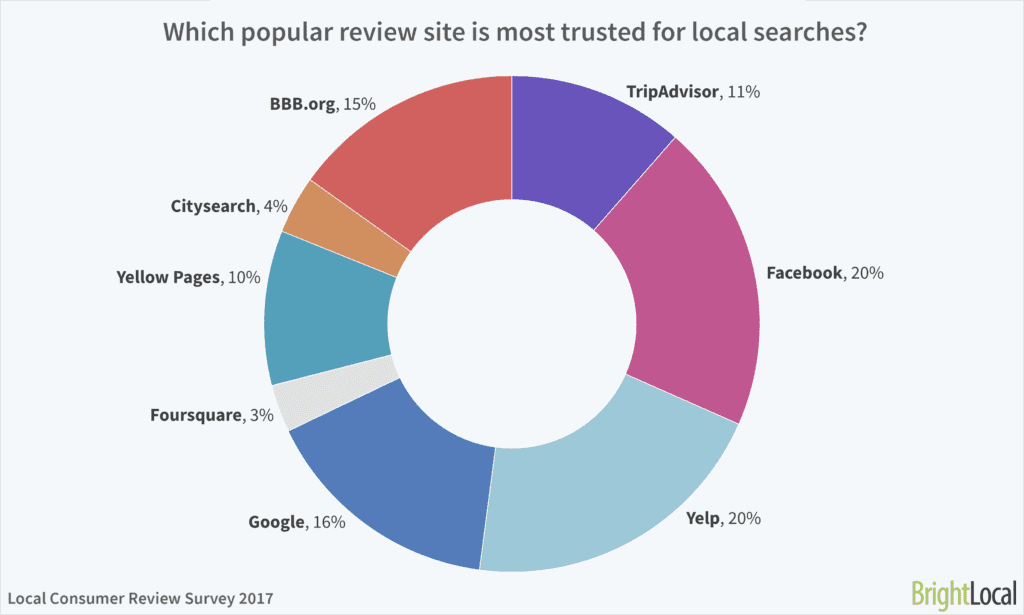
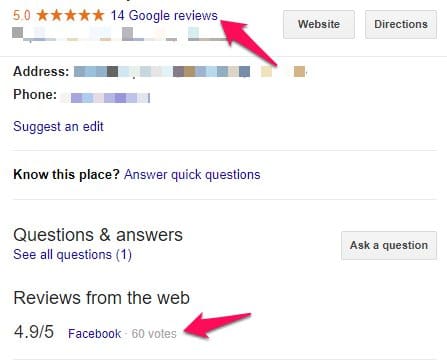 Google has long surfaced review data from other platforms alongside its Business Profiles (pictured on the right), so reviews earned elsewhere still contribute to how your business appears in Google. Getting established on Yelp, Facebook, and the directories relevant to your industry strengthens your local SEO and keeps your business visible no matter where customers search.
Reviews and AI Search
There’s a newer reason to care about reviews in 2026: AI search. When someone asks ChatGPT, Perplexity, or Google’s AI Overviews for “the best HVAC company near me,” those tools lean heavily on review volume, ratings, and the actual text of reviews to decide which businesses to recommend. A business with plenty of recent, detailed, positive reviews gives an AI assistant something concrete to cite. A business with three reviews from 2019 gives it nothing. The same review strategy that helps your map rankings now also determines whether AI tools mention you at all.
Conclusion: Do Google Reviews Help SEO?
Yes. Directly for local map pack rankings, where Google confirms review signals as part of prominence. Indirectly for organic rankings, through click-through rate, engagement, and trust. And increasingly for AI search visibility, where reviews are raw material for recommendations. For reviews to pay off, though, your website and your Business Profile both need to be optimized to deliver value to the people your reviews attract.
How Can I Get More Google Reviews?
Give your customers the opportunity. More often than not, a customer only leaves a review when something has gone wrong. To earn positive reviews, you have to be proactive: ask at the moment of satisfaction, make the link one click away, and follow up once. We wrote a full guide on how to get more reviews for your small business. And if you want to see how your reviews, listings, and rankings stack up right now, our free marketing audit checks your review profile alongside six other areas of your online presence.
Google Reviews and SEO FAQ
Do Google reviews help ranking in the map pack?
Yes. Google states that review count, review quality, and ratings factor into local ranking as part of prominence. Combined with relevance and distance, they help determine which businesses appear in the local map results.
How many Google reviews do I need for SEO?
There’s no set number. What matters is having more high-quality, recent reviews than the competitors you’re trying to outrank, and keeping them coming steadily. A slow, consistent stream of genuine reviews beats a one-time burst, which can even look suspicious.
Do Google reviews help organic (non-map) rankings?
Not directly. Reviews aren’t an organic ranking factor. They help indirectly by increasing your click-through rate from search results and building the trust that turns visitors into customers, which supports stronger performance over time.
Should I respond to Google reviews?
Yes, to all of them, positive and negative. Responses show Google and potential customers that the business is active and engaged, and a professional reply to a bad review often does more for trust than another 5-star review.